For Sale: A Piece of Sephardic and Romaniote History in Crete


Tucked down one of Chania’s narrow alleyways, the Etz-Hayyim synagogue in Crete is easy to miss, marked only by a Hebrew inscription and a security buzzer. The synagogue and the adjacent library are the last surviving remnants of Chania’s Jewish heritage. Today, that history is at risk of getting even smaller.
This neighborhood was a vibrant Jewish quarter until the community was wiped out in WWII. Now, the library’s building is up for sale. If Etz Hayyim isn’t able to raise enough funds to purchase it, the space will likely be turned into tourist infrastructure. With the fundraising deadline approaching, the organization is turning to the international community for help.
“Our work is to preserve a European Jewish tradition and culture that otherwise would be completely lost,” Adi Levant, the Fundraising Manager at Etz Hayyim, told us.
Romaniote and Sephardic communities used to have a presence in the major Cretan cities of Heraklion, Rethymno, and Chania. Etz Hayyim is the only remaining Jewish place left on the island. The archival collection in the library is an important piece in understanding and preserving that history.
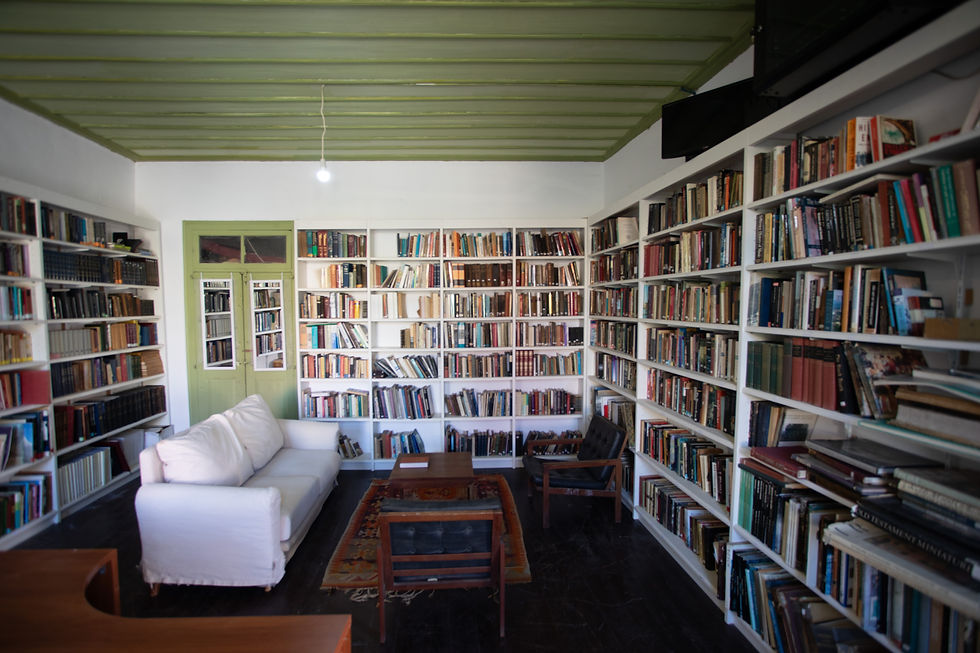
The library is home to over 6000 titles. “The main focus is Jewish history and tradition, with a focus on Sephardi and Romaniate sources,” Anja Zuckmantel, the organization’s executive director, told us.
Some notable books in the collection include: Jewish Salonica, Translation and Survival: The Greek Bible of the Ancient Jewish Diaspora, Ladino Rabbinic Literature and Ottoman Sephardic Culture, and a classical Jewish antique set with writings from Philo, Josephus, and other classical Jewish writers and thinkers.

But it’s the archives that contain “micro-histories” - letters, journals, recipes - found in the library that have helped historians paint a picture of what Jewish life might have looked like on Crete.
“The archival material allows us to illuminate the story of the community, which is the main focus of our work,” Anja said.
While the loss of the building wouldn’t lead to the loss of the library’s collections, it would restrict access and hinder research. With limited real estate space in the old town, Anja said that if they lose the building, the next location of the archives would be boxes. “We might be pushed into the new town, which disconnects us from the place.”
Adi told us, “All the buildings inside the old Jewish quarter are very close to one another. The library is right in the synagogue; it’s hard to imagine that something else would be there. It’s [right] above our backyard, where we have the tombstones of the previous Rabbis of the community.
In 2010, two arson attacks were carried out against the synagogue and library, damaging the collection of books, archives, and CDs. If the building is lost to Airbnb or a hotel, security risks are front of mind for the synagogue.
"If there’s an exchange of people we don’t have control over, then we just don’t know who’s there,” Adi said.
Not only is it a security risk, but if tourists are sunbathing or partying over the place where the tombstones and Mikva are located, it’s inappropriate for the location.
Most tourists don’t know that they’re standing in the Jewish quarter when they come to this part of Chania. And that’s because most locals don’t, either. Losing the library would mean losing another part of that heritage.

If the organization can buy the building, they hope to open it to the public, so that residents and tourists can learn more about the Jewish history on Crete.
“As an Israeli, I never heard about the Romaniote culture. There is a narrative about what the Jewish cultures are around the world, and it was fascinating to see there’s a space that’s dedicated to preserving this tradition,” Adi said.
Even though much of the area’s Jewish history is buried or repurposed, historians at the synagogue have been able to uncover key sites from the old Jewish quarter. Thanks to their research, they can now offer walking tours that bring this hidden history to light.
Owning the building would open up more research opportunities through partnerships with universities and academic institutions. “It’s such a small area of research, so I think for anyone studying the Romaniote and Cretan tradition, we are one of the only spaces where [they] can come study,” Adi said.
A new volunteer from Ireland is helping Etz Hayyim revamp the library’s structure and online presence. “We hope this is going to be the beginning of the next major step in preserving the library and its history,” Anja said.
The fundraising campaign will run until the end of August 2025. You can learn more about the campaign here.


It is disappointing not to find here the name of Nikos Stavroulakis, z"l, who was behind the original restoration of the Hanya synagogue and library. He was also the founder of the Jewish museum of Athens.
Kayla, Thank you for sharing this - beautiful corner to be saved and cherished. Will follow. Sheila