Sephardic Rabbis and Leaders from 12 Countries Gathered in New York to Build a Stronger Voice in Jewish Institutional Life


A two-day summit proudly organized by the Sephardic Brotherhood of America, the Habura, and UJA-Federation of New York brought together more than 150 rabbis, scholars, and communal leaders to strengthen the future of Sephardic Jewish life
NEW YORK, NY — Sephardic Jews make up a major part of the global Jewish population, yet their voices and leadership traditions have long operated on the margins of a Jewish institutional landscape shaped largely by Ashkenazi-dominated organizations. This past month, that gap narrowed considerably.
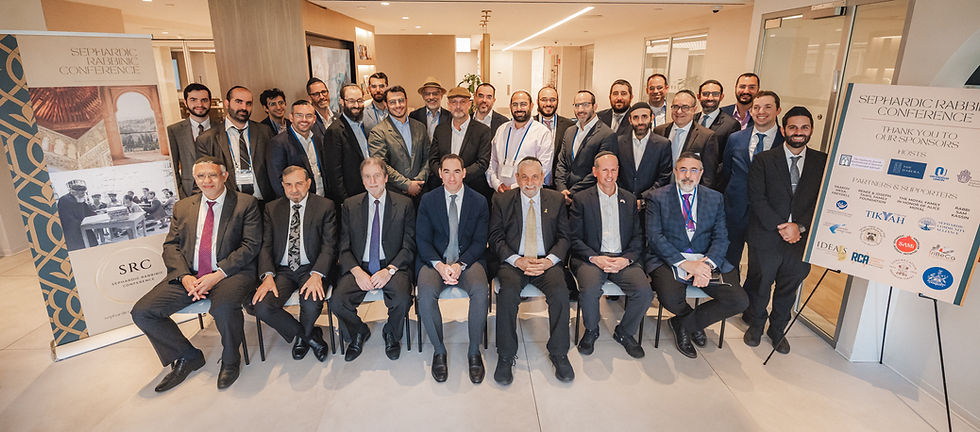
Some 150 rabbis, rebbetzins, communal leaders, and young professionals from a dozen countries — from Istanbul to Mexico City, Amsterdam to Brooklyn - convened at UJA-Federation of New York's Manhattan headquarters for the second annual Sephardic Rabbinic Conference (SRC), a gathering organized around the theme "The Art of Leadership." The conference was convened by three core hosts: the Sephardic Brotherhood of America and The Habura, joined this year for the first time by UJA-Federation of New York - a partnership organizers point to as a marker of the community's growing institutional standing. Sessions over the two days covered halachic authority, mental health, pastoral care, connecting to Israel, and what organizers described as the urgent work of building long-lasting Sephardic institutions in the diaspora.

"There's clearly been a lack of [Sephardic] representation in a lot of mainstream Jewish institutions — in federations, in schools — a lack of our needs being seen and heard," said Ethan Marcus, managing director of the Sephardic Brotherhood of America and co-organizer of the conference alongside Avi Garson, co-founder of The Habura, an online and physical Jewish study center. "Whether it's a Moroccan, Turkish or Spanish Portuguese community, they may differ from what you would say mainstream Ashkenazi communities need," Marcus told Jewish Insider.
That the conference took place this year at UJA-Federation's own headquarters, and with the backing of a roster of major Jewish institutions, including the Orthodox Union, the Rabbinical Council of America, the World Zionist Organization, World Mizrahi, and KKL-JNF. This long list in and of itself, Marcus argued, evidence that the status quo is beginning to shift.

"These organizations are stepping up and saying, 'We want to hear from you and what your unique ideas and needs are, and what you also have to offer the wider Jewish world,'" Marcus said. "We believe there's a lot the wider Jewish world can take away from the Sephardic path we're pushing. This idea of a middle-of-the-road approach steeped in Jewish traditions but fully engaged with the challenges and benefits of the modern world. To us that's very much the Sephardic approach, and it's something that all Jewish people can benefit from."
From a Magazine Essay to a Movement
The conference's origins trace back to a set of questions Garson raised in a piece for La Djente in our Winter 2025 Edition: Where is Sephardic leadership coming from? Where is it being trained? And who is going to lead and represent the community in the years ahead?
"One thing led to the other and we realized we should put everyone together in the same room," Garson told Jewish Insider, reflecting on last year's inaugural gathering, which centered on the theme of education and drew roughly 40 rabbis and community leaders from six countries. "We realized there's a real deep ongoing desire to connect — for everyone to get together and discuss these issues and collaborate."

This year's expanded event, Marcus said, represents a "turning point in the Sephardic world, where all of these synagogues and people are recognizing we need to work together." "We can be uniquely our own identities; the Sephardic world is not a monolith," he said. "Moroccan Jewish communities, Syrian Jewish communities all have their unique customs and traditions, but there's a lot more that unites us than divides us. But we don't have to get rid of our self-identities. "
That openness extended to the conference's speaker roster, which included not only Sephardic rabbis but Ashkenazi voices and speakers from outside the Jewish community entirely. The goal, Garson said, is "to bring in good ideas and best practices to help our community, which in turn can help the Jewish community more broadly" — a principle he traced back to Maimonides, the medieval Sephardic sage who famously championed: "Hear the truth, whoever speaks it."
Featured Speakers and Participants
Speakers and participants included:
Rabbi Dr. Marc D. Angel — rabbi emeritus of Congregation Shearith Israel and leading voice of the Spanish and Portuguese Sephardic tradition
Rabbi Haim Sabato — renowned Israeli rabbi, author, and educator
Rabbi Dr. Ratson Arussi — leading authority and spiritual leader of the Yemenite Jewish community
Rabbi Harold Sutton — leading rabbinic figure in the Syrian Jewish community
Rabbi Dr. J.J. Schacter — Yeshiva University
Rabbi Gad Bouskila — prominent leader of the Moroccan Jewish community
Yaakov Hagoel — chairman of the World Zionist Organization
Ofir Akunis — consul general of Israel in New York
Daniel Rosenthal — vice president of government relations at UJA-Federation
Rabbi Elie Buechler — director of programs at the Orthodox Union Advocacy Center
They were joined by dozens of additional rabbis and communal representatives from Sephardic communities across North America, Europe, Central and South America, the Middle East, and beyond.
A Community Not on the Margins, but Ahead of the Curve

Organizers pointed to data suggesting Sephardic and Mizrahi Jews are punching above their demographic weight in American Jewish life. Despite making up an estimated 10% of the American Jewish population, Sephardic and Mizrahi Jews in the U.S. report higher rates of Jewish communal participation, stronger connection to Israel, and are more likely to say that being Jewish is somewhat or very much a part of their daily life, compared to Ashkenazi Jews, according to a 2025 report by JIMENA (Jews Indigenous to the Middle East and North Africa).
That vitality is visible just blocks from where the conference was held: on Manhattan's Upper East Side, the Sephardic community has been steadily establishing itself, anchored by institutions like the Moise Safra Center, the 14-story community center that opened on East 82nd Street in 2018 and marked a demographic shift for the neighborhood.
Angel: "We Don't Want to Preserve a Sephardic Heritage — We Want It to Live"
The conference's evening reception featured an address from Rabbi Marc Angel, rabbi emeritus of Shearith Israel — the Spanish and Portuguese Synagogue on Manhattan's Upper West Side, which he led from 1969 to 2007 — titled "Beyond Ethnicity: What Will Sephardic Judaism Mean 50 Years From Now?"
Rejecting a model of cultural preservation in favor of a religious and cultural heritage he described as evolving, Angel argued that Shearith Israel — North America's oldest Jewish congregation, tracing itself back to 1654 — serves not as an ethnic relic to be safeguarded but as a guide for the future of Diaspora Jewry.
"People speak of preserving the Sephardic heritage. I do not agree," Angel said. "You preserve fish, you preserve fruit, you preserve things that are dead. Something alive grows and evolves. We don't want to 'preserve' a Sephardic heritage; we want it to live; we want to draw on our past and bring it to life in new ways, to breathe wisdom and spirituality that can continue to fill our lives and inspire our future generations."
"People admire our history, as do I," he continued. "But when I look at our synagogue I don't only see the past. I see a taste of the future of the Jewish people. We thrive as a synagogue in the Western Sephardic tradition, a tradition of formality, elegance, supreme reverence for God … but we are not only an 'ethnic' congregation."
Angel recalled that when he first walked into the Spanish and Portuguese Synagogue 60 years ago, at least half the congregants were Ashkenazi. "And most of the Sephardim were themselves either married to Ashkenazim or their children were married to Ashkenazim," he said. "In other words, our congregation flourished as a Sephardic congregation because it attracted those of various backgrounds who found the Western Sephardic traditions to be spiritually compelling to them."
Looking three or four generations ahead, Angel predicted that Sephardic practice will continue to draw Jews of all backgrounds.
"What will draw them to the Sephardic traditions? What are basic ingredients in Sephardic civilization that are relevant and meaningful to all thinking Jews, regardless of ethnicity? Actually, we have a lot of powerful traditions — intellectual, cultural, synagogal — that will attract a great many people. I like to speak of 'Sephardism' — Sephardic civilization — beyond ethnicity."
Program Highlights
Across the two days, the conference featured keynote addresses, panel discussions, workshops, and networking opportunities covering:
The Rabbi as Community Leader
Halakhic Leadership in the Modern World
Artificial Intelligence and Technology
Mental Health and Pastoral Care
Public Speaking and Communication
Israel Advocacy and Jewish Leadership
Building Stronger Jewish Communities
Spotlight on Sephardic Communities Around the World
A community dinner and concert of Sephardic liturgy was held on the evening of Monday, August 17, at the historic Congregation Shearith Israel, bringing conference participants together with communal leaders and supporters.
Partnering Institutions
Attendees included rabbis from a wide range of communities, among them Syrian, Persian, Greek, Turkish, Moroccan, Iraqi, and Spanish & Portuguese traditions.
They were joined by Sephardic leaders from diverse communities across the U.S. and abroad — including Seattle, Miami, Los Angeles, London, Stockholm, Jerusalem, Abu Dhabi, and Mexico City — representing a coalition of institutions.
The gathering marked one of the first times that diverse Sephardic communities from around the world have united behind a major initiative, transcending cultural divides and embracing what organizers describe as a shared, positive-sum vision for the future of Sephardic Jewish leadership — one Marcus summed up simply: "Jewish unity doesn't mean Jewish uniformity."


Comments