The Streets of Rhodes Remember

Updated: Jul 24

Visiting the island of Rhodes has always given me a sense of longing. There’s something in the air, especially in the early hours before the sun rises, when a cool breeze moves through these empty, quiet streets. The place feels suspended in time, it seems. It’s hard to explain, but there’s a lingering absence that cannot be replaced, as I take a deep breath and begin my morning walk.
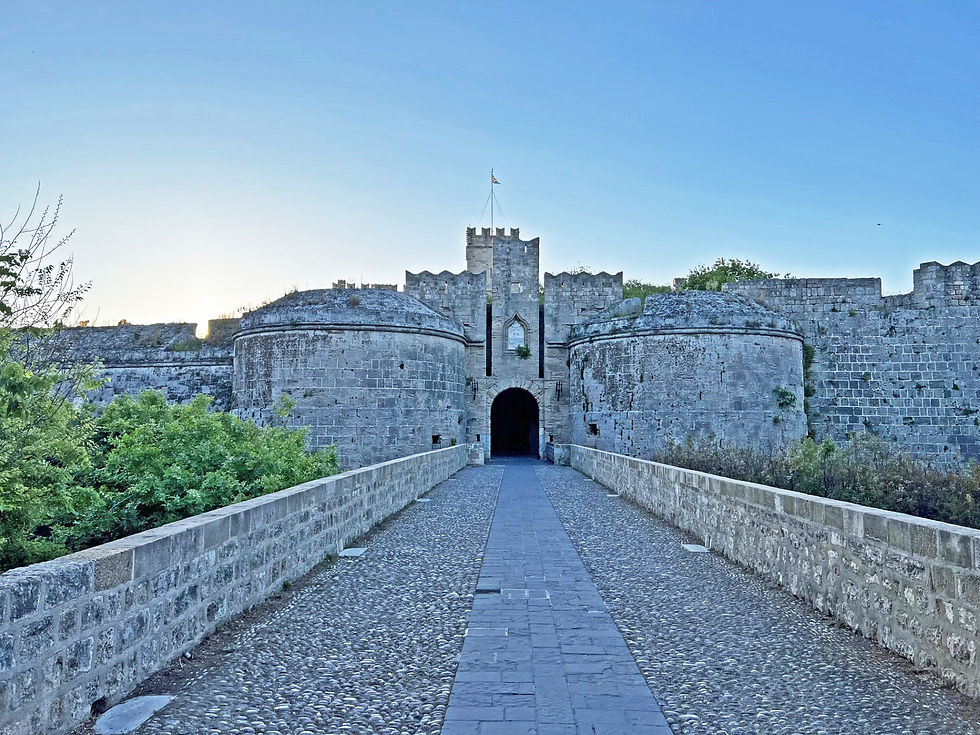
To reach La Juderia, I follow the route from my hotel along Riga Fereou, formerly Via dell’Immacolata, just outside the medieval walls. After a few meters, you’re at the old Air Force Command Center, where the Jews of Rhodes were held prior to their deportation to Auschwitz. In 2014, a memorial plaque was placed in front of the building at the cross streets of Navarinou and Dimokratias. I then go toward Parko Platanakia to enter the Gate d’Amboise, where you cannot miss its two massive bastions, like giant sentinels. Inside, you’ll pass a walkway lined with tall trees providing shade, while half-awake cats dozed, perfectly tucked on the worn contours and indentations of these stones. Inside the walls, three landmarks come into view: on the left stands the Palace of the Grand Master of the Knights, along Ippoton Street, once known as Via dei Cavalieri. In front of me is Orpheus Street, with its Medieval Clock Tower, which has stood strategically at the highest point of the Old Town. Right next to it is the Mosque of Suleiman the Magnificent, with its domes, minaret, and articulated façade along Apollonion Street, formerly Via P. del Ponte.
From there, I take Sokratous Street, previously known as Via Mercato Vecchio. In my 2004 interview with the late Joseph D. Alhadeff, I learned that a section of Sokratous was called by the Jews as Arriva del Kadir, meaning “Ottoman authority,” since the Turkish district and its administrative center once stood here. This is still evident in the well-preserved architecture, such as Ottoman-style houses with protruding balconies known as “sahnisia”. At the lower end of Sokratous was once a thriving Jewish business square, with an ornate fountain at its center. It was known as Tcharshi Kemado, or Piazza del Fuoco, named after a fire that occurred there.

A wide variety of Jewish shops flourished, including silversmiths and tinsmiths, shoemakers and leatherworkers, jewelers, hat makers, textile merchants, herbalists, vendors of baked goods, dried fish, and aboudaju, as well as household suppliers, to name a few. From the steps of Castellania, next to the Dante Alighieri Library, one can still see the façades of former commercial buildings, such as the Salomon Alhadeff department store and two separate Alhadeff banks established by the brothers Salomon and Isacco. Today, this area is known as Ippokratous Square, a bustling hub filled with visitors frequenting its restaurants and shops during the summer season.
I continue my walk to the end of Aristotelous, formerly Via Venezia, toward the main street of La Juderia, called La Kay Ancha. Known as the “wide street,” it was formerly Piazza Principe Umberto di Savoia, where the landmark seahorse fountain, built by the Italians, still stands. This area was affectionately known as the heart of the Jewish Quarter. Today, it is known as Platia Evreon Martiron. As the late Rebecca Amato Levy mentions in her book, I Remember Rhodes, Jewish families settled around La Kay Ancha, inhabiting ten main streets and several smaller ones. Next to the seahorse fountain is a small park, where a six-sided black granite monument was placed in 2002 in memory of the Holocaust victims of the Jewish Communities of Rhodes and Cos. Every year, many Rhodesli descendants, guest speakers, and leaders of organizations from around the world travel to Rhodes for the July commemorative events organized by the Jewish Community. A few steps from the Holocaust Memorial is the entrance to Perikleos Street, formerly Via Sigismondo Malatesta, also known by its nickname, El Datilar, after a date tree that once stood there.

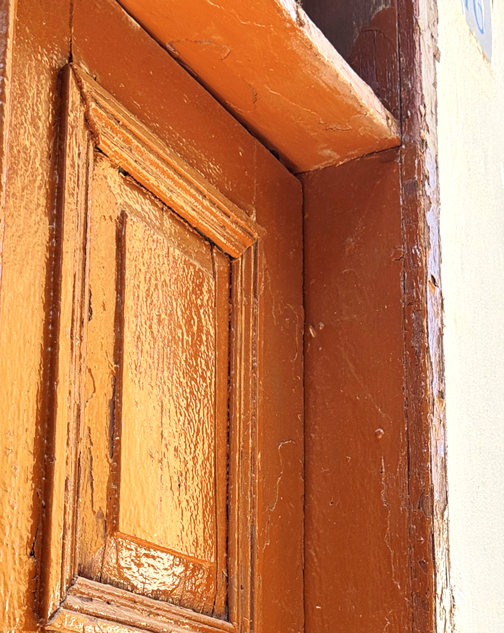
I proceed to see the home of my great-grandparents, Israel and Rachel (née Levy) Hasson, who once lived at 16 Via Sigismondo Malatesta (now Perikleos). The modest house, while showing signs of wear, remains solid, having endured the test of time. The doors and windows have been kept shut. Yet in the silence, a trace of its past remains: on the doorframe, faint but unmistakable, the mark of where a mezuza was once affixed is still visible. A signal to pause for reflection.
I then move toward the streets where the Kahal Shalom Synagogue is located. Previously, these streets had many names: Via della Sinagoga della Pace, Via Ugo Milanese Pepe, Via Benvenuto Giorgio (now Dosiadou), and Via Andrea Birago(now Simiou). To the Rhodeslis, the area was known as La Kay Kehila Shalom, as well as La Kay de la Busana, because it often had cold winds. A few steps past Kahal Shalom, a small street called Fidiou opens to the left. It was formerly known as Via Chenan and Via Giovanni Parpaglia, with nicknames Kalijika de Canaan or Las Sietes Kalijikas. In one of my previous walks in La Juderia that I shared with my cousin Stella Levi, we stopped in front of her former home at 1 Via Chenan (now Fidiou), where a rounded stone still exists next to the doorway. “You see that stone,” Stella said, “that is where my grandmother, Mazaltov Halfon, used to sit.”

As I venture into another street, recalling its Ladino name, I’m reminded that the Juderia of my ancestors is no longer what it once was; however, their memory does not vanish here. You call the name of the street, and it remembers. The stones of these walkways hold that memory. Our families’ footsteps left traces on these sheshikus they once walked on. Their life stories are etched on each doorstep, in what remains of their homes, in the windows and the cortijus they once used, or in the shops they once owned. These streets bear witness and will not forget. Then I shall do the same.


Aron thank you for this tour. I’m hope to take my children and grandchildren to Rhodes this summer. This will be a fantastic resource
Michele Arougheti Greenfield
Aron, Your words didn’t just tell a story,they transported me. I found myself feeling incredibly emotional, remembering the people, the places, and the spirit of Rhodes.. Thank you for writing something so thoughtful, and so full of heart. It truly touched me. Hazak U’Baruch! ❤️
Thank you for this article, I saw two of my family names on the Jewish business square map. Turiel, my grandmother, and Mizrahi my grandfather. I hope to visit Rhodes soon,
-Chilly Nathan
Thank you for your your wonderful tour of the streets of Rhodes! I enjoyed reading, learning and seeing the photos of this beautiful town that I hope to visit one day! I have attended one of your luncheons on Wilshire in LA and have copies of your books filled with history and amazing photos of family! Thank you!